Three Newly Added Scholarship Opportunities for High School Seniors in Spring 2026
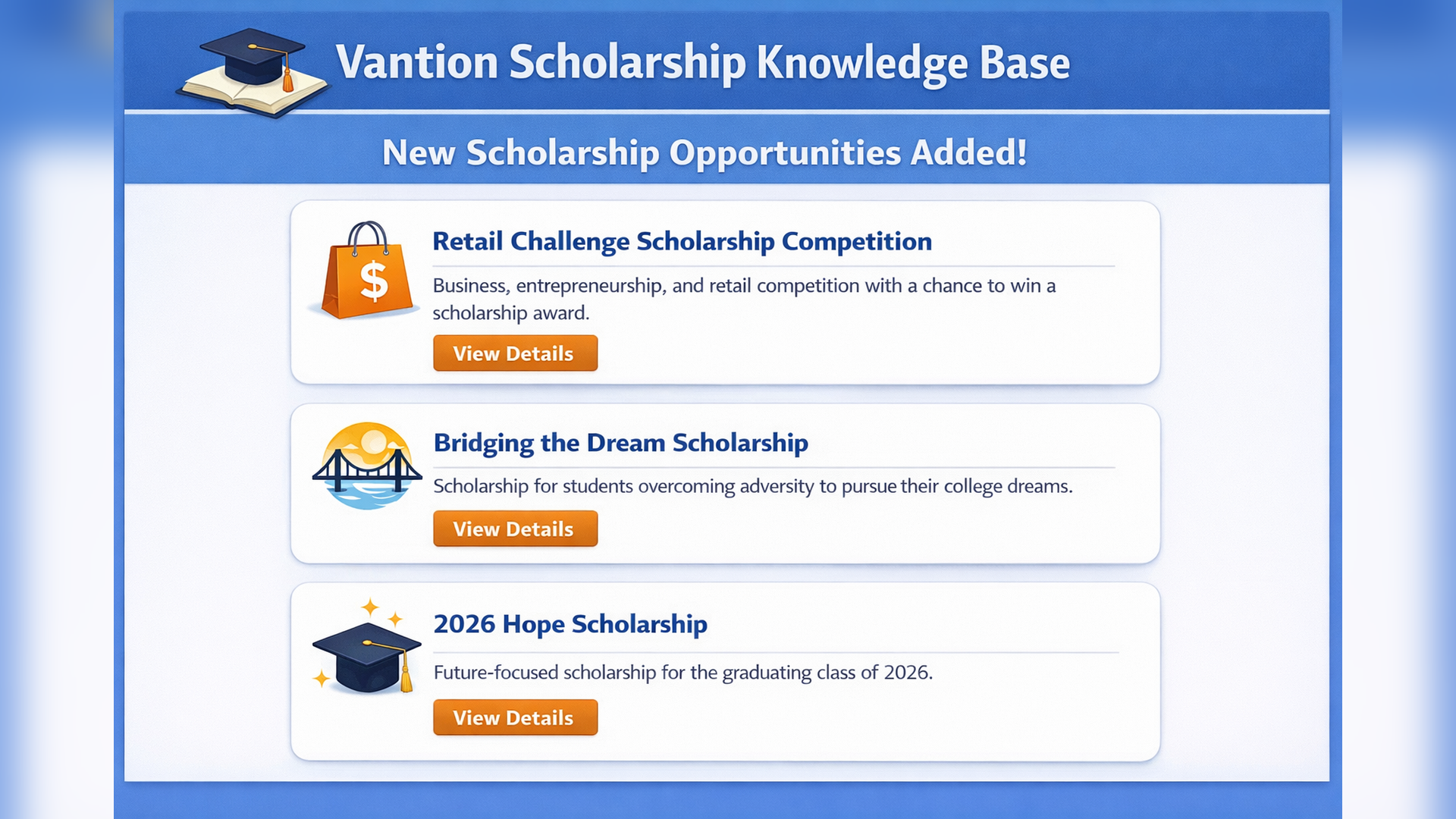
The three newest additions to the Vantion Scholarship Knowledge Base represent three very different scholarship models offered for high school seniors in Spring 2026. The Inaugural Retail Challenge Scholarship Competition from the Illinois Retail Merchants Association (IRMA) is a team-based business pitch competition due March 30, 2026. The TMCF / Sallie Mae Bridging the Dream Scholarship closes April 24, 2026 and will award up to $10,000 to 30 Pell-eligible seniors heading into higher education. The Bank of Hope 2026 Hope Scholarship closes May 1, 2026 at 5:00 p.m. EST and offers $2,500 per student.
IRMA’s competition stands out because it functions more like a pre-college innovation challenge than a conventional scholarship. Illinois high school seniors must work in teams of two to four, choose a retailer prompt, and submit a written business idea, a 20-slide pitch deck, and a 90-second video. A maximum of five teams advance to a live final round in Springfield. The awards are unusually large for a high school competition: first place is $60,000 per team, second place $40,000, third place $20,000, and honorable mentions pay $1,000 per student. IRMA says the funds can be used within the first year after graduation for educational expenses at an approved postsecondary institution, including tuition, fees, books, supplies, and on-campus room and board.
That structure makes IRMA especially attractive for students who are already thinking entrepreneurially. Because the application asks for market definition, community impact, launch steps, a polished presentation, and a video pitch, it rewards students who can do more than write a personal statement; it rewards collaboration, problem framing, and execution. For applicants interested in retail, marketing, supply chains, customer experience, or startup-style problem solving, this is the most portfolio-driven opportunity of the three.
The TMCF / Sallie Mae Bridging the Dream Scholarship is different in both scale and intent. TMCF says the program will support 30 current high school seniors with awards of up to $10,000 for the 2026-2027 academic year, paid in two installments. Applicants must be graduating seniors from the 2025-2026 school year who plan to enroll full-time as first-time freshmen, maintain at least a 2.75 cumulative GPA, be Pell-Grant eligible, and be U.S. citizens or legal permanent residents. Eligible enrollment pathways include accredited two-year schools, four-year schools, and vocational or technical certificate programs.
Bridging the Dream is not just a GPA screen. The program explicitly asks applicants to demonstrate leadership and good moral character, and the official rules require a transcript, a FAFSA Student Aid Report for the 2026-2027 aid year, and a video response explaining the core principles or values the student believes are essential to creating positive change in their community and future career field. In practice, that makes this a national, access-oriented scholarship that pairs financial need with a values-and-leadership narrative.
Bank of Hope’s 2026 Hope Scholarship is the most geographically targeted of the three. The program offers $2,500 per student and is open to 2026 high school graduates who will enroll as incoming freshmen at either a two-year or four-year institution. Applicants must be U.S. citizens, nationals, or legal permanent residents, have a minimum unweighted 3.0 GPA or a GED, and demonstrate financial need under the program’s income restrictions. Unlike the TMCF program, eligibility is limited by geography: applicants must live in selected counties in California, New York, New Jersey, Georgia, Illinois, Washington, Alabama, and Texas, or in Hawaii.
The Bank of Hope application is also document-heavy, which means students should prepare well before the May 1 deadline. The bank says the submission is one-time only and cannot be edited once started. Required materials include a parent or guardian’s 2025 income tax return showing the applicant as a dependent, a recommendation letter sent directly by the recommender, a transcript, and a roughly 500-word essay in PDF form. Applicants choose between two prompts: one focused on hardship and growth, and another focused on leadership and impact.
Taken together, these three additions show how broad the scholarship landscape has become. IRMA rewards team-based problem solving and presentation skills. Bridging the Dream centers nationwide college access for Pell-eligible seniors who can pair need with leadership and purpose. Bank of Hope focuses on students in specific communities who can document both financial need and academic readiness. For students building a 2026 application calendar, the lesson is simple: these are not interchangeable opportunities. Each one favors a different applicant profile, and the strongest strategy is to match effort to fit rather than apply to all three with the same materials.